
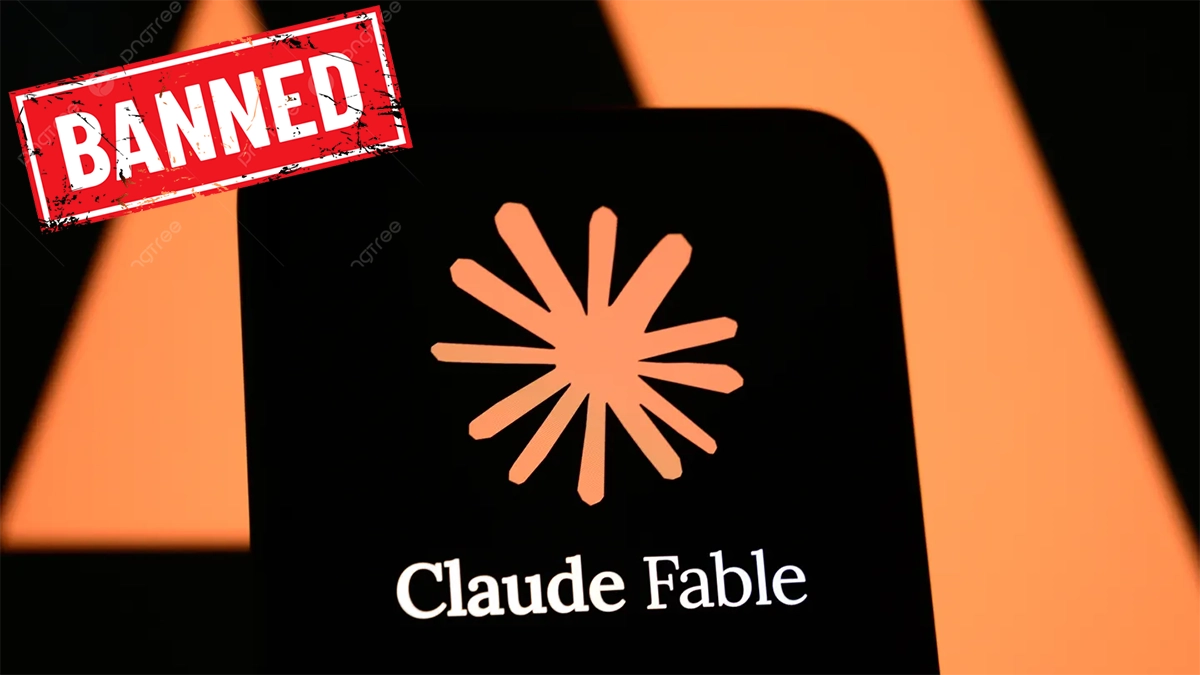
Three days. That’s how long Claude Fable 5 and Claude Mythos 5 were available before the US government told Anthropic to pull the plug on both of them, worldwide, for everyone.
If you tried to use either model this weekend and got an error, you weren’t imagining it. Friday evening, an export control directive landed on Anthropic’s desk. Saturday morning, the company’s most capable models were gone — not just for “foreign nationals,” which is technically what the order targeted, but for every single user, including paying US customers. Here’s how a launch that Anthropic was clearly proud of turned into a regulatory standoff in under 72 hours.
What Fable 5 and Mythos 5 actually
On June 9, Anthropic introduced something new: a “Mythos class” of models sitting above Opus in capability. Mythos itself had already been quietly running since April under Project Glasswing, a cybersecurity-focused pilot with a small number of partner organizations. Fable 5 was the public-facing version — same underlying model as Mythos 5, but wrapped in a layer of safety classifiers.
The idea was clever, at least on paper. If you asked Fable 5 something that tripped a classifier in a high-risk category — cybersecurity, biology, chemistry, or anything related to building frontier AI models — it would quietly hand the request off to the weaker Opus 4.8 instead of the full Mythos-class model, and (in most cases) tell you that happened. Anthropic said over 95% of sessions never triggered this at all, so for almost everyone, Fable 5 just felt like the new best model. The 5% that did trip it got a deliberately dumbed-down answer.
It’s a reasonable bet. It’s also a bet that depends entirely on the classifiers actually working.
Then Pliny showed up
Within a day of launch, a well-known AI red-teamer who goes by Pliny the Liberator posted that he’d broken through. The methods he described weren’t exotic zero-days — they were the greatest hits of jailbreaking: swapping in look-alike Cyrillic characters so banned words don’t get flagged, spreading a sensitive request across a long conversation so no single message looks dangerous, dressing requests up as fiction or academic exercises, and breaking one bad request into a dozen individually harmless-looking steps.
He posted screenshots claiming the bypassed model produced working exploit code and chemical synthesis instructions, including specifics for a meth-cooking method. He also said he’d extracted and published Fable 5’s system prompt — reportedly around 120,000 characters of internal instructions governing how the model behaves.
Anthropic’s response was, essentially, “we know about this.” The company said it had reviewed the demonstration and concluded it surfaced a small number of previously known, minor vulnerabilities — not a serious break of the safeguards separating Fable from the underlying Mythos model.
Then the government got involved
Whatever Anthropic’s internal read on the severity, someone else clearly disagreed. Reports point to Amazon — a major Anthropic investor and its primary cloud provider — as the “trusted partner” who flagged the jailbreak to Washington. By Friday at 5:21pm ET, Anthropic had a letter from the Commerce Department, reportedly drafted with input from Commerce Secretary Howard Lutnick’s Bureau of Industry and Security, invoking national security authorities.
The order itself was oddly shaped: suspend all access to Fable 5 and Mythos 5 by any foreign national, anywhere, including Anthropic’s own foreign employees. Anthropic said it had no way to carve out access that precisely on short notice, so the “net effect” was disabling both models for absolutely everyone. Existing sessions errored out. New requests got quietly rerouted to Opus 4.8. Anthropic says it’s the first time a frontier lab has taken a publicly deployed model fully offline because the federal government told it to.
Anthropic’s public statement was polite but unmistakably annoyed. The company said it was complying, but called the move a possible “misunderstanding,” argued that pulling a commercial model used by hundreds of millions of people over one narrow jailbreak finding would set an industry-wide precedent for halting deployments, and said it was working to restore access as fast as possible. No promises about other models being affected — those are apparently fine.
Two very different stories about why
This is where it gets messy. A day later, David Sacks — co-chair of the President’s Council of Advisors on Science and Technology and the administration’s former AI czar — posted his own account on X, and it does not match Anthropic’s version at all.
According to Sacks, the White House gave Anthropic a direct choice before the order ever went out: fix the jailbreak, or take the models down voluntarily. He says Dario Amodei refused both, and the export control was issued “reluctantly” as a result. Sacks also pushed back hard on Anthropic calling the jailbreak “not serious,” arguing that a bypass enabling what he characterized as cyberweapon-level capability is hard to describe as minor — especially coming from a company that has built its brand on taking safety more seriously than anyone else.
Anthropic, for its part, says it received the directive with zero specifics about what the national security concern even was. Both of these things can’t really be true at once, and as of Sunday neither side had walked anything back.
The fallout, and what comes next
The reactions outside the two main parties are almost more interesting than the dispute itself. French MEP Jordan Bardella seized on it as a sovereignty argument — proof, in his framing, that countries without their own frontier AI labs are at the mercy of US policy decisions, and a reason for Europe to back homegrown alternatives like Mistral. Separately, there’s word that the Department of Defense had already soured on Anthropic over a related dispute and cut off contractor access before this even happened, which suggests the relationship between Anthropic and parts of the US government was fraying well before Friday’s letter.
One AI executive’s take stuck with me: this might function as a glorified marketing stunt in the end — a few days of downtime that only proves how good Fable 5 was — but that doesn’t make the precedent any less unsettling. A government agency can apparently order a company’s flagship product offline globally on a few hours’ notice, over a dispute about how serious a jailbreak is, with the two sides not even agreeing on what was said.
As of Sunday, June 14, both models are still down. Sacks says restoration just requires Anthropic to patch the vulnerability and that the administration wants this resolved fast. Anthropic hasn’t given a timeline. Everything else in the Claude lineup — Opus 4.8 included — is running normally, so if you need a frontier-ish model right now, that’s your option.
Whether this turns out to be a weekend blip or the first real test of how much control governments can exert over deployed AI models probably depends on how the next few days go. I’d keep an eye on it either way.
For Latest Tech Updates Please follow us :
facebook | twitter | instagram | telegram | whatsapp